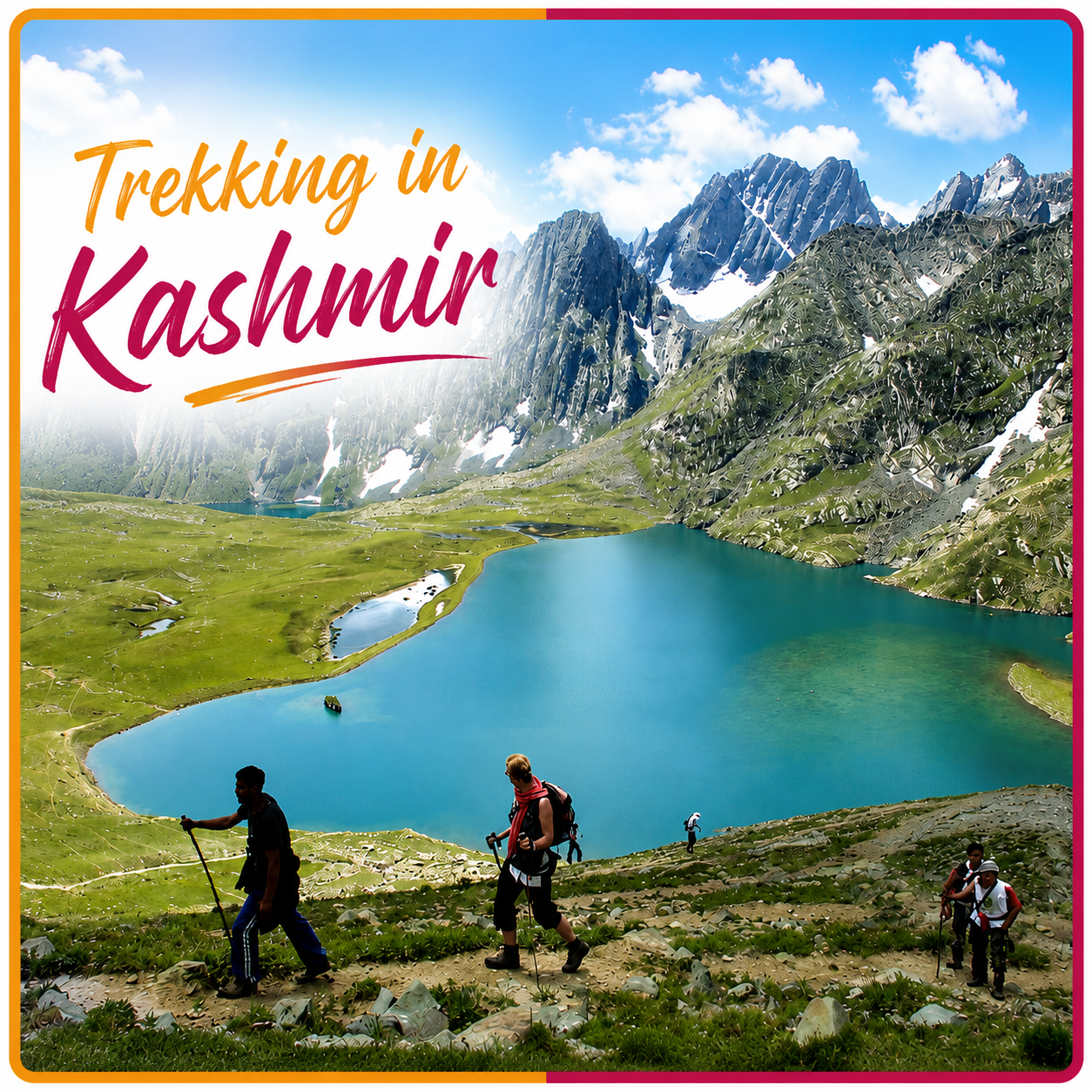
Trekking in Kashmir is best done between June and September when high-altitude trails are snow-free and accessible. The most popular Kashmir trek is the Great Lakes Trek — a 7-day, 72 km route passing 7 alpine lakes at 3,500–4,100 metres. Kashmir trekking packages start from ₹12,000 per person for a guided 7-day trek.
Table of Contents
Why This Guide Exists
We have been taking trekkers into the Kashmir Himalayas for 12 years at Namaste Yatra Travels. We have done the Great Lakes Trek in June when the snow is still chest-deep on the passes, in August when the meadows are carpeted with wildflowers, and in September when the first autumn frost turns the grass gold. We have carried first-time trekkers through Gadsar Pass at 4,085 metres and guided experienced mountaineers through routes that most operators do not even know exist.
This guide is built entirely from that direct, repeated, on-the-ground experience — not from travel aggregators or secondhand research. Every route description, difficulty rating, cost figure, and seasonal tip comes from treks we have personally led or organised.
1. Why Kashmir Is One of India's Finest Trekking Destinations
After 12 years of leading groups on Kashmir trek routes, we can say this clearly — the Kashmir Himalayas offer something very few trekking destinations in the world can match: extraordinary alpine landscapes at relatively accessible altitudes, a diversity of routes from beginner-friendly glacier walks to challenging high-altitude passes, and a trekking season that overlaps perfectly with the main Kashmir tourism window.
Here is what makes trekking in Kashmir genuinely exceptional:
- Alpine lakes at every turn. The Kashmir great lakes trek alone passes 7 high-altitude lakes — Vishansar, Kishansar, Gadsar, Satsar, Gangabal, Nundkol, and the turquoise waters of Tarsar and Marsar on extended routes. Each one is different. Each one is extraordinary.
- Wildflower meadows that rival anything in Europe. In July and August, the meadows above 3,000 metres in Kashmir are covered in alpine flowers — yellow, purple, blue, and white — in a density that experienced trekkers consistently describe as the most beautiful they have seen anywhere in the Himalayas.
- Accessibility from Srinagar. Most Kashmir trek routes start within 2–3 hours of Srinagar city. You can fly from Delhi, arrive in Srinagar, and be on the trail the next morning.
- Relatively lower altitude. Unlike Ladakh where most treks operate above 4,500 metres, the flagship Kashmir trekking routes operate between 3,000 and 4,200 metres. Acclimatisation is easier, altitude sickness risk is lower, and the routes are accessible to fit first-timers without mountaineering experience.
- No crowds. The Great Lakes Trek, Gadsar Lake, and the alpine lakes in Kashmir are visited by a fraction of the trekkers who go to popular Himachal or Uttarakhand routes. The wilderness experience is genuine.
- Experienced local trek guide
- All camping equipment (tents, sleeping bags, mats)
- All meals on trek (breakfast, lunch, dinner)
- Porters for group equipment
- Inner Line Permit arranged
- Sonamarg to Naranag transport
- Basic first aid kit Mid-Range Package — ₹18,000–₹25,000 per person (7 days)
- Higher quality camping equipment
- More comfortable tent arrangements
- Pre-trek acclimatisation day in Srinagar
- Better quality meals with fresh ingredients
- Dedicated trek coordinator What Is NOT Included in Most Kashmir Great Lakes Trek Packages
- Srinagar accommodation before and after the trek
- Personal trekking gear (boots, jacket, backpack, poles)
- Travel insurance
- Emergency evacuation (available as an add-on)
- High passes may still have significant snow cover
- Routes below 3,500m are fully open
- Excellent for Thajiwas Glacier and Tulian Lake treks
- Great Lakes Trek possible but for experienced trekkers only
- Meadows just beginning to show green growth
- All major routes fully open
- Wildflower meadows at peak bloom above Nichnai and around Gadsar Lake
- Weather mostly stable with occasional afternoon rain
- Our top recommendation for first-time Kashmir trek participants
- Kashmir lake trek routes at their most photogenic
- Clear views and fully open passes
- Alpine lakes in Kashmir at their deepest, most vivid colour
- Best month for Kashmir great lakes trek photos
- Slightly more trekkers on routes than July
- Afternoon thunderstorms possible — always be in camp by 2 pm
- Cool, crisp mornings ideal for high passes
- Autumn colour beginning on lower slopes
- Fewer trekkers — quieter trails
- The best month for Kashmir great lakes trek photos with golden light
- Snow may begin on higher passes in late September
- First heavy snowfall typically arrives mid to late October
- Great Lakes Trek and Gadsar routes close by October 15
- Thajiwas Glacier accessible until first heavy snow
- Not recommended for multi-day high-altitude routes
- Thajiwas Glacier walk: suitable for everyone — no prior experience needed
- Tulian Lake Trek (2–3 days): suitable for active beginners
- Great Lakes Trek (KGL trek): requires good fitness and ideally one prior multi-day high-altitude trek
- Gadsar and Tarsar Marsar routes: prior high-altitude experience required Step 2 — Choose Your Month
- Ankle-support trekking boots — waterproof, broken in before the trek
- Do not arrive with new boots — blisters at 3,500m are serious
- Trail running shoes are not suitable for the KGL trek and Gadsar routes
- 2 moisture-wicking base layer tops
- 1 fleece mid-layer
- 1 waterproof and windproof outer jacket — essential
- 2 pairs of trekking trousers — convertibles work well
- Thermal bottoms for night time and high passes
- Warm hat, sun hat, and neck gaiter
- Gloves — even in August at the passes
- Sleeping bag rated to at least -5°C
- Personal sleeping bag liner — significantly improves comfort and hygiene
- Offline maps downloaded before departure — Maps.me or OsmAnd
- Personal headtorch with spare batteries
- Basic personal first aid kit
- Altitude sickness medication (Diamox) — consult your doctor before the trek
- Reusable water bottles — 2 litres minimum capacity
- Water purification tablets
- High-SPF sunscreen — UV at 4,000m is intense
- UV-blocking sunglasses
- High-quality lip balm with SPF
- Government photo ID (Aadhaar or passport)
- Inner Line Permit — your operator provides this
- Emergency contact list
- Travel insurance documents
2. Best Trekking Routes in Kashmir — Complete Overview
Here is a complete overview of every major trekking in Kashmir route — from beginner glacier walks to challenging high-altitude circuits.
| Trek Name | Duration | Max Altitude | Difficulty | Best Season |
|---|---|---|---|---|
| Great Lakes Trek (KGL) | 7–8 days | 4,191m | Moderate–Hard | July–September |
| Thajiwas Glacier Trek | Half day – 1 day | 2,800m | Easy | May–October |
| Gadsar Lake Trek | 5–6 days | 4,085m | Moderate–Hard | July–September |
| Tarsar Marsar Trek | 6–7 days | 4,100m | Moderate | July–September |
| Kolahoi Glacier Trek | 5–6 days | 3,900m | Moderate | June–September |
| Sinthan Top Trek | 2–3 days | 3,748m | Easy–Moderate | June–September |
| Tulian Lake Trek | 2–3 days | 3,685m | Easy–Moderate | June–September |
| Sonamarg to Gangabal | 3–4 days | 4,000m | Moderate | June–September |
Each route is described in detail in the sections below. We cover the three most popular in full — the Great Lakes Trek, Thajiwas Glacier, and Gadsar Lake — as they collectively account for over 80% of Kashmir trekking bookings every season.
3. Kashmir Great Lakes Trek — The Flagship Kashmir Trek
What Is the Kashmir Great Lakes Trek?
The Kashmir Great Lakes Trek — also known as the KGL trek — is a 7 to 8 day high-altitude circuit through the Sonamarg and Gangabal regions of the Kashmir Himalayas, passing 7 of the most beautiful alpine lakes in Kashmir. It is widely considered one of the top 5 treks in India and the single finest trekking experience in Kashmir.
The route covers approximately 72 km at altitudes between 2,850 metres and 4,191 metres, passing through meadows, high mountain passes, glacial moraines, and pristine alpine lake basins.
We have done the KGL trek 14 times across 12 years — in snow, in rain, in clear blue August skies, and in the early September cold when the air tastes like ice. It is different every time and extraordinary every time.
Kashmir Great Lakes Trek Route — Day by Day
Day 1 — Sonamarg to Nichnai (3,500m)Drive from Srinagar to Sonamarg (80 km, 2.5 hrs). The trek begins at Shikargah camp near Sonamarg at 2,800m. Gradual ascent through pine forests and alpine meadows to Nichnai camp at 3,500m.
Distance: 11 km | Ascent: 700m | Time: 5–6 hours | Stay: Camp, NichnaiDay 2 — Nichnai to Vishansar Lake (3,710m)
Climb to Nichnai Pass (4,100m) — the first high pass of the KGL trek map route. The descent reveals the first breathtaking alpine meadow of the trek. Camp at the shore of Vishansar Lake — a deep blue glacial lake set against a wall of snow peaks.
Distance: 10 km | Max altitude: 4,100m | Time: 6–7 hours | Stay: Camp, Vishansar LakeDay 3 — Vishansar to Gadsar Lake (3,600m)
Cross Gadsar Pass (4,085m) — the highest point of the standard Kashmir great lakes trek route. Descent to the Gadsar valley with views of Gadsar Lake below — a long, turquoise-green lake flanked by ridges. This is one of the finest viewpoints on the entire 7 lakes trek Kashmir.
Distance: 13 km | Max altitude: 4,085m | Time: 7–8 hours | Stay: Camp, Gadsar LakeDay 4 — Gadsar to Satsar (3,800m)
A day of relative recovery — shorter distance, gentler terrain. Pass through the Satsar meadows, a series of 7 small lakes, and camp above the main Satsar lake basin. Wildlife is common here — Himalayan marmots, golden eagles, and occasionally the elusive Hangul deer.
Distance: 10 km | Time: 4–5 hours | Stay: Camp, SatsarDay 5 — Satsar to Gangabal Lake (3,576m)
The most scenic day of the Kashmir great lakes trek. Cross the Zajibal Pass and descend to the twin lakes of Gangabal and Nundkol — two extraordinary bodies of water set against the massive granite face of Harmukh peak (5,142m). Camp here for the night with Harmukh reflecting in the lake.
Distance: 13 km | Time: 6–7 hours | Stay: Camp, Gangabal LakeDay 6 — Gangabal to Naranag (2,128m)
The long descent from the alpine zone back to the tree line and road head at Naranag. Through birch forests, shepherd settlements, and the ancient ruins of Naranag temple at the trail's end.
Distance: 14 km | Descent: 1,450m | Time: 6–7 hours | Stay: Naranag or drive to SrinagarDay 7 — Naranag to Srinagar (Drive)
Drive back to Srinagar (50 km, 2 hours). Trek complete.
Kashmir Great Lakes Trek — Key Facts
| Detail | Information |
|---|---|
| Start point | Sonamarg (Shikargah), 80 km from Srinagar |
| End point | Naranag, 50 km from Srinagar |
| Total distance | 72 km (standard route) |
| Max altitude | 4,191m (Zajibal Pass) |
| Difficulty | Moderate to Hard |
| Best months | July, August, September |
| Permits required | Yes — Inner Line Permit from Srinagar |
| Recommended group size | 4–12 trekkers |
What Is the Best Time for the Kashmir Great Lakes Trek?
The best time for Kashmir great lakes trek is July to September. Here is a month-by-month breakdown:
JunePasses are partially snow-covered. The trek is possible but challenging. Vishansar and Gadsar lakes may still be frozen. Recommended only for experienced trekkers comfortable on snow and ice. July
All major routes are fully open. The wildflower meadows are at peak bloom — the meadows above Nichnai and around Gadsar Lake are extraordinary. Weather is mostly stable with occasional afternoon rain. Our top recommendation for first-time Kashmir trekkers. August
The best all-round month. Clear views, fully open passes, and stable morning weather. The alpine lakes in Kashmir are at their deepest and most vivid colour. Kashmir great lakes trek photos taken in August consistently produce the most dramatic images. September
Cool, crisp mornings. Fewer trekkers. The best month for Kashmir great lakes trek photos with golden light and blue skies. Snow may begin to appear on the higher passes in the last week of September. October onwards
The passes close with heavy snowfall. The trek is not recommended after October 15.
What Is the Kashmir Great Lakes Trek Cost?
The Kashmir great lakes trek cost for a fully guided, all-inclusive package starts at ₹12,000 per person. Here is the complete breakdown:
Budget Package — ₹12,000–₹16,000 per person (7 days)All of the above, plus:
Kashmir Great Lakes Trek Map — The Route Visualised
The Kashmir great lakes trek map follows a single-direction circuit from Sonamarg in the west to Naranag in the east, crossing three high passes — Nichnai Pass at 4,100m, Gadsar Pass at 4,085m, and Zajibal Pass at 4,191m — and descending through the Gangabal basin.
It is not a loop. The start and end points are different, so two vehicles or a return drive is required.
We provide a detailed digital KGL trek map to every trekker we take on this route, showing campsites, water sources, emergency exit points, and altitude profiles.
For the official trail information, refer to the Jammu & Kashmir Tourism Department.
4. Thajiwas Glacier Trek — Best Kashmir Trek for Beginners
What Is the Thajiwas Glacier Trek?
The Thajiwas Glacier trek in Sonmarg is the most accessible trekking experience in all of Kashmir — a short walk or pony ride from Sonmarg town to one of the most dramatic glacier formations in the Western Himalayas.
Unlike the Great Lakes Trek, the Thajiwas glacier Sonmarg walk requires no prior trekking experience, no permits, and no camping equipment. It is the perfect introduction to Kashmir's alpine world for non-trekkers, families, and couples.
We take our non-trekking Kashmir tour clients to Thajiwas Glacier as a half-day activity from Sonmarg — and without exception, it produces some of the most memorable moments of their entire trip.
How to Reach Thajiwas Glacier
The Thajiwas Glacier sits approximately 3 km from Sonmarg town at an altitude of 2,800m. Here are the three ways to reach it:
Option 1 — Walk (45–60 minutes each way)A well-marked, moderately uphill path from the Sonmarg main road. Suitable for fit individuals. The walk through birch forests and stream crossings is beautiful in its own right. Best done in the morning when the light on the glacier is clear. Option 2 — Pony Ride (30 minutes each way)
Horses and ponies are available from the Sonmarg taxi stand. Cost: ₹400–₹600 per person one way, ₹700–₹1,000 return. The pony ride is the most popular option for families and couples. Option 3 — Snow Scooter (Winter and Spring)
Available when Sonmarg receives heavy snowfall, typically November to May. The snow scooter ride to the glacier is exhilarating and a highlight for winter visitors. Cost: ₹500–₹800 per person.
Thajiwas Glacier — Key Facts
| Detail | Information |
|---|---|
| Location | Sonmarg, 80 km from Srinagar |
| Altitude | Approximately 2,800m at the glacier face |
| Sonmarg to Thajiwas Glacier Distance | 3–4 km from Sonmarg town centre |
| Entry fee | None (Sonmarg vehicle entry fee: ₹50–₹100) |
| Best time to visit | May to October (peak: June–August) |
| Time needed | 3–4 hours total, round trip |
| What to bring | Warm jacket, sunscreen, water, trekking shoes |
Is Sonamarg Glacier the Same as Thajiwas?
Yes. Sonamarg glacier and Sonmarg glacier both refer to the Thajiwas Glacier — it is the main glacier visible from and accessible to Sonmarg. The terms glacier Kashmir and sonamarg glacier are used interchangeably in search results but all refer to the same Thajiwas formation.
→ Read our full guide: Sonamarg Valley Kashmir — complete travel guide
5. Gadsar Lake & Alpine Lakes Trek {#gadsar-lake}
What Is the Gadsar Lake Trek?
Gadsar Lake is a high-altitude glacial lake at 3,600 metres in the Sonamarg-Gangabal region of Kashmir, accessible via Gadsar Pass at 4,085 metres — one of the highest passes in the Kashmir trekking network.It forms a key part of both the full Kashmir great lakes trek (where it is one of the 7 alpine lakes in Kashmir on the route) and can also be done as a standalone 5 to 6 day trek for those who do not have time for the full KGL circuit.
The approach to Gadsar Lake via Gadsar Pass is one of the most dramatic in all of Kashmir trekking in Kashmir routes. The pass itself opens to a sudden, breathtaking view of the Gadsar valley and lake below. Every trekker we have taken across this pass has stopped at the top and gone silent for a moment.
Gadsar Pass — Key Facts
| Detail | Information |
|---|---|
| Gadsar Pass altitude | 4,085 metres |
| Difficulty | Hard — steep on both sides, snow until July |
| Recommended for | Trekkers with prior Himalayan experience |
| Permit required | Yes — Inner Line Permit |
| Best time | July to early September |
Other Alpine Lakes in Kashmir Worth Trekking To
The alpine lakes in Kashmir go far beyond the Great Lakes Trek circuit. Here are the major ones:
Tarsar and Marsar LakesTwo high-altitude lakes in the Aru Valley behind Pahalgam, accessible on a 6 to 7 day trek. Tarsar at 3,800m is teardrop-shaped and brilliant turquoise. Marsar at 4,078m is more remote and rarely visited. One of the finest and least-crowded Kashmir lake treks available. Gangabal and Nundkol Lakes
The twin lakes at the end of the Great Lakes Trek — set against the granite face of Harmukh peak. Gangabal at 3,576m is accessible on a shorter 3 to 4 day trek from Naranag. One of the most dramatic camp settings in the Kashmir Himalayas. Vishansar and Kishansar Lakes
Two glacially-fed lakes in the upper Sonamarg region, accessible on Day 2 of the Great Lakes Trek. Vishansar at 3,710m is deep blue and surrounded by grassy slopes. Together they form one of the most beautiful lake basins in the 7 lakes trek Kashmir route. Kashmir Alpine Trek — High-Altitude Options
The Kashmir alpine trek routes that go above 4,000m include the Kolahoi Glacier approach, the traverse above Satsar, and the high route above Gangabal basin. These are for experienced mountaineers and trekkers comfortable at extreme altitude.
6. What Is the Best Season for Trekking in Kashmir? {#best-season}
The best season for trekking in Kashmir is June to September. High-altitude passes are snow-free from July onwards. June is the shoulder month — passes begin to clear but some routes still have deep snow. October sees early snowfall and most high-altitude routes close by mid-October.Here is a complete month-by-month trekking calendar:
June — Shoulder Season
July — Peak Wildflower Season ★ Recommended for First-Timers
August — Best All-Round Month
September — Best for Photography and Fewer Crowds
October — Route Closure Month
→ Read the full seasonal guide: Best time to visit Kashmir
7. How to Plan Your Kashmir Trek — Step by Step
This is the exact process we use when planning every Kashmir trekking departure. Use it as your complete planning checklist.
Step 1 — Choose Your Route Based on ExperienceBe honest about your fitness level.
July and August are the safest and most rewarding months for first-timers on any Kashmir trek. September is excellent for experienced trekkers seeking fewer crowds and better photography light. Avoid June for high passes unless you have snow trekking experience.
Step 3 — Book a Reputable Kashmir Trek OperatorSolo trekking without a guide is strongly discouraged on the KGL trek and Gadsar routes. Trails are not consistently marked, weather changes rapidly, and altitude emergencies require trained response. A good operator provides a certified guide, a cook, camping equipment, porters, permits, and emergency support.
→ Contact Namaste Yatra Travels for Kashmir trekking packages
Step 4 — Arrive in Srinagar One Day EarlyDo not arrive in Srinagar and start the trek the same day. Spend at least one night at 1,730m (Srinagar's altitude) to begin acclimatisation before ascending to 3,500m on Day 1. This one day makes a significant difference to how your body handles the altitude gain.
Step 5 — Arrange Your PermitsThe Great Lakes Trek, Gadsar route, and several other Kashmir trekking routes require an Inner Line Permit from the Forest Department in Srinagar. Your trek operator handles this. Never start the trek without the permit — rangers check at multiple points on the trail.
Step 6 — Sort Your Gear Before You Leave HomeDo not rely on renting trekking gear in Srinagar. Bring your own: trekking boots that are broken in, a warm sleeping bag rated to -5°C or below, a waterproof jacket, trekking poles, and sun protection. Rental gear in Srinagar is available but inconsistent in quality.
8. Kashmir Trekking Packages — Cost & What Is Included
What Do Kashmir Trekking Packages Include?
A standard Kashmir trekking package from a reputable operator includes a trek guide, a camp cook, camping equipment (tents, sleeping bags, mats), all meals on trek, porters for group gear, permits, and transport to and from the trailhead. Personal trekking gear is not included.
Thajiwas Glacier Half-Day Trip (Beginner)
This is a guided half-day excursion from Sonmarg — not a full trekking package.
| Detail | Information |
|---|---|
| Cost | ₹800–₹1,500 per person |
| Duration | 3–4 hours |
| Included | Guide, basic first aid, pony option |
| Difficulty | Easy |
Kashmir Great Lakes Trek Package (7 Days)
| Package Tier | Cost Per Person | Group Size |
|---|---|---|
| Budget | ₹12,000–₹16,000 | 6–12 trekkers |
| Mid-Range | ₹18,000–₹25,000 | 4–8 trekkers |
Included in all tiers: Guide, cook, camping equipment, all trek meals, Inner Line Permit, trailhead transport
Not included: Srinagar accommodation, personal gear, travel insurance, emergency evacuation
Gadsar Lake Trek Package (5–6 Days)
| Detail | Information |
|---|---|
| Cost | ₹10,000–₹18,000 per person |
| Difficulty | Higher than KGL — experienced trekkers only |
| Includes | Guide, cook, camping, all meals, permits, transport |
Tarsar Marsar Trek Package (6–7 Days)
| Detail | Information |
|---|---|
| Cost | ₹11,000–₹20,000 per person |
| Starting point | Aru Valley, Pahalgam |
| Includes | Guide, cook, camping, all meals, permits |
| Note | One of the most underrated Kashmir trekking packages |
Group Size and Pricing
Most Kashmir trekking packages are priced per person for a minimum group of 4. Solo trekkers and pairs pay a supplement of ₹2,000–₹4,000 above the listed per-person price. Groups of 8 or more qualify for group discounts.
→ Full Kashmir trip budget guide
→ All Kashmir tour packages
9. What to Pack for a Kashmir Trek
This packing list is built from 12 years of taking trekkers on Kashmir trekking routes. Everything here comes from real experience of what people needed — and what they wished they had brought.
Footwear
Clothing
Sleeping
Navigation & Safety
Hydration & Sun Protection
Documents
10. Essential Trekking Tips from 12 Years of Kashmir Experience
These are not generic tips from a travel blog. These are lessons from 12 years and hundreds of Kashmir trek departures — including the mistakes we have seen trekkers make and the things that consistently made the difference between an extraordinary experience and a difficult one.
Start slow on Day 1.The most common mistake is going too fast on the first day. The KGL trek Day 1 ascent from 2,800m to 3,500m is relatively gentle but the body is not yet acclimatised. Walk at a pace where you can always hold a conversation. Rushing on Day 1 leads to headaches and nausea on Day 2 at altitude. Drink 3–4 litres of water every day on the trek.
Altitude dehydration is the most common cause of altitude sickness. Drink more water than you think you need. Avoid alcohol for the first two days on the trail. Turn around if you develop a severe headache that does not resolve.
On the Gadsar Pass and Zajibal Pass sections, some trekkers develop acute mountain sickness symptoms. The rule is simple — if you have a headache, rest. If the headache does not improve after rest and water, descend immediately. No viewpoint is worth risking altitude sickness. The weather changes fast above 3,500m.
Always carry your rain jacket and warm layer accessible — not packed at the bottom of your bag. July and August bring afternoon thunderstorms in the mountains. Always be at or near camp by 2 pm on exposed sections of the Kashmir great lakes trek route. Trust your guide on the KGL trek map route — even when you think you know better.
The trails on the Kashmir great lakes trek are not always obvious. There are misleading shepherd trails that branch off the main route. Your guide knows the correct path. On our 14 Great Lakes Trek departures, the moments where trekkers ignored guide advice were the only navigation difficulties we ever had. The wildflowers peak in the first two weeks of August.
If you want Kashmir great lakes trek photos that look like they were taken on another planet — all green and gold with flowers as far as the eye can see — aim for the first two weeks of August. This is the single best week for the trek in our 12 years of experience. Carry cash in small denominations.
There are no ATMs on the Kashmir trek routes. Carry enough cash for the full duration of the trek plus a 20% buffer for unexpected expenses — pony hire, emergency supplies, additional warm clothing from shepherd camps.
11. Frequently Asked Questions
What is the best trek in Kashmir for beginners?
The best Kashmir trek for beginners is the Thajiwas Glacier walk in Sonmarg — a 3 to 4 hour round trip accessible to everyone with no prior trekking experience required. For those ready for a multi-day trek, the Tulian Lake Trek (2–3 days, max 3,685m) near Pahalgam is the most beginner-friendly overnight option. The Great Lakes Trek is suitable for fit beginners who have completed at least one prior day trek at altitude.
→ Read the Gulmarg tour package guide for more adventure options near Gulmarg.
How difficult is the Kashmir Great Lakes Trek?
The KGL trek is rated moderate to hard. It requires good cardiovascular fitness, the ability to walk 10–14 km daily for 6 consecutive days, and comfort with crossing high passes at 4,000–4,191m on uneven, sometimes snow-covered terrain. Prior trekking experience at altitude above 3,000m is strongly recommended. First-time trekkers who are physically fit and well-prepared complete this trek successfully every season.
What is the Great Lakes Trek cost in 2026?
The Kashmir great lakes trek cost in 2026 ranges from ₹12,000 to ₹25,000 per person for a fully guided, all-inclusive 7-day package — including guide, cook, camping equipment, all meals, permits, and trailhead transport. This does not include Srinagar accommodation, personal trekking gear, or travel insurance. Groups of 8+ qualify for group discounts.
How many lakes are there on the Great Lakes Trek?
The standard KGL trek passes 7 main alpine lakes in Kashmir — Vishansar, Kishansar, Gadsar, Satsar (a chain of smaller lakes), Gangabal, and Nundkol. Extended versions of the route include Tarsar and Marsar lakes, bringing the total to 9. The term 7 great lakes of Kashmir or 7 lakes trek Kashmir refers to the seven main lakes on the standard circuit.
What is the best month for trekking in Kashmir?
July and August are the best months for trekking in Kashmir — high passes are fully open, wildflowers are at peak bloom, weather is mostly stable, and the alpine lakes in Kashmir are at their most vivid. September is excellent for experienced trekkers seeking fewer crowds and better photography light. June is suitable for lower-altitude routes only. October sees the routes begin to close with snowfall.
What permits are required for trekking in Kashmir?
The Great Lakes Trek, Gadsar route, Tarsar Marsar, and several other high-altitude routes require an Inner Line Permit from the Jammu & Kashmir Forest Department. Your trek operator arranges this. Do not attempt to start the trek without it. Foreign nationals require additional documentation. The Thajiwas Glacier walk does not require a trekking permit.
Can I do the Great Lakes Trek without a guide?
We strongly advise against solo trekking on the Kashmir great lakes trek without a certified guide. The trails are not consistently marked, weather can change rapidly, altitude emergencies require trained response, and Inner Line Permits require a licensed operator. The cost difference between guided and unguided is not significant enough to justify the safety risk at altitude.
Is trekking in Kashmir safe?
Yes. Trekking in Kashmir is safe when done with a reputable, licensed operator, proper equipment, and appropriate fitness preparation. The Kashmir Himalayas are not technically challenging in the way that Ladakh or Spiti routes can be. The Great Lakes Trek and Gadsar routes involve no rock climbing, roping, or technical mountaineering. The main risks are altitude sickness (manageable with proper acclimatisation) and weather changes (manageable with a good guide).
What is the KGL trek map route?
The KGL trek map follows a one-direction circuit from Sonamarg (west) to Naranag (east), crossing three high passes — Nichnai Pass (4,100m), Gadsar Pass (4,085m), and Zajibal Pass (4,191m) — and passing through 7 alpine lake basins. It is not a loop. Trailhead is at Sonamarg and end point is at Naranag (50 km from Srinagar).
12. About the Author {#author}
Amit RajKashmir Trekking Expert & Founder, Namaste Yatra Travels
Amit has been trekking the Kashmir Himalayas for 12 years — completing the Great Lakes Trek 14 times across all months of the summer season, leading groups on the Gadsar, Tarsar Marsar, Kolahoi Glacier, and Thajiwas Glacier routes, and building Kashmir trekking packages for hundreds of individual trekkers and groups from across India.
Every route description, difficulty rating, seasonal recommendation, and cost figure in this guide comes from direct, personal, on-the-ground experience — not from secondhand research.
Ready to Trek Kashmir?
Whether you want the beginner-friendly Thajiwas Glacier walk or the full 7-day Kashmir Great Lakes Trek, Namaste Yatra Travels builds fully customised trekking packages for every fitness level, group size, and budget.
→ View all Kashmir tour packages
→ Contact us for a personalised Kashmir trekking package